The email was perfect. Four paragraphs, a clear recommendation, risks listed, alternatives considered. Then we got into a room and I asked one question about why they picked option B over option A.
Silence. Then a nervous laugh. "Oh, I need to ask my AI."
That is the part that gets me. Not the tool. The laugh. They knew. The person who signed their name to the recommendation could not tell me why it was the right one.
The polish test
I have seen this in person more than once. A strong written argument turns up in email or Slack, thorough and verbose and well structured. Then the conversation starts and the person clams up. They cannot defend the decision, and they cannot entertain a different approach, because they never built the argument in the first place.
The document is meant to be strong enough that nobody needs to argue with it. The writer hopes the volume of text ends the discussion before it begins.
Here is the test.
-
Take any written recommendation on your team.
-
Sit down with the author for ten minutes with no doc open.
-
Ask them why.
-
Then ask what would change their mind.
-
Then ask for the strongest argument against it.
Someone who did the thinking answers all three without effort. They may be rough, they may contradict themselves, but the reasoning is theirs and you can hear it. Someone who outsourced the thinking has nothing to reach for.
Verbose writing alone proves nothing. Plenty of people write long emails and know every line. This is a conversation test, not an AI detector. The writing is the claim. The conversation is the proof.
How to spot it
None of these prove anything on their own. Together they make a pattern worth a closer look.
-
The emails are long and full of explanation. Every point is covered, every risk is hedged, and the length is out of proportion to the question asked.
-
The chat replies are verbose, but slow. On Slack or Teams you never see the "typing..." indicator blink on and off. Nothing, then a flood of text arrives all at once. That is a paste, not someone thinking out loud.
-
The video call has long pauses and fillers. They stall, say "that's a great question," or trail off while they wait on the tool to do the work.
If you see two or three of these, do not accuse anyone. Run the polish test.
What the research says
I am not the only one worried about this, though the evidence is early and I will not oversell it.
Microsoft Research and Carnegie Mellon surveyed 319 knowledge workers and collected 936 first-hand examples of using generative AI at work. Higher confidence in the AI was associated with less critical thinking. Higher confidence in your own ability was associated with more. The authors are clear that this does not establish causation. It still points at what I keep seeing in meetings.
A separate study from the MIT Media Lab had 54 participants write essays over several sessions. One group used an LLM, one used a search engine, one used nothing. The LLM group showed the weakest brain connectivity on EEG, reported the lowest ownership of their essays, and struggled to accurately quote their own work. Read that last one again. They could not quote what they had supposedly written.
The MIT paper is a small sample from a narrow population, and the authors say so themselves. Treat it as a signal, not a verdict. It still matches the nervous laugh.
The whiteboard
In engineering, the whiteboard is where the magic happens. A few people, one marker, an argument. Nobody is immune from being challenged. No sacred cows. Your seniority does not defend the design. Only your understanding does.
Strong engineers excel there because the only tool in their hand is a marker. They cannot paste a prompt. They hold the model of the problem in their head, draw it, take a hit, and adjust.
That is the skill that erodes when you stop doing the reasoning. Writing fluency and thinking fluency are different things. AI hands you the first one for free. It cannot hand you the second.
AI gives you one opinion
I am not anti-AI. It is a great advocate and a great learning tool. It is not a replacement for thinking and understanding.
Whatever it gives you is one opinion, no matter how good the model seems. There is always an alternative. There is always something it does not know that could change the answer.
It also follows the crowd. It was trained on what people built, so if everyone built something a given way, it is very likely to offer you that same way. It will often recommend outdated libraries for the same reason. The most common answer is not automatically the right answer for your system, your constraints, or this year.
Take the output at face value and you inherit all of that without knowing it. Then someone at the whiteboard asks why you chose that library and you have nothing.
Do this instead
Read what the AI gives you and argue with it. Ask what it assumed. Ask what the alternative is and why it lost. Find the thing it does not know about your situation.
Before you send a recommendation, close the doc and explain it out loud to an empty room. If you cannot, you are not ready to send it.
If you manage people, run the polish test on your team this week. Ten minutes, no doc, three questions. Do it kindly. The goal is to find who needs help building the habit, not to catch anyone out.
And if you hear yourself say "I need to ask my AI" in the middle of a meeting, stop. Pick up the marker.
A wonderful accelerant
AI is a wonderful accelerant. It has changed the way everyone engages at work, and that is not going back.
But it behaves like the blowhard at the dinner table. It proclaims something with such confidence that you feel embarrassed to question it, or to probe deeper, for fear of looking bad. Question it anyway. Confidence is a delivery style, not evidence.
Software engineers in particular fear losing the art of writing code. Let it go. It is lost. But the real value of your skill, the real reason you exist, has never been stronger. Code was never the point. Understanding the problem, weighing the options, and defending the choice is the point, and that part is still yours.
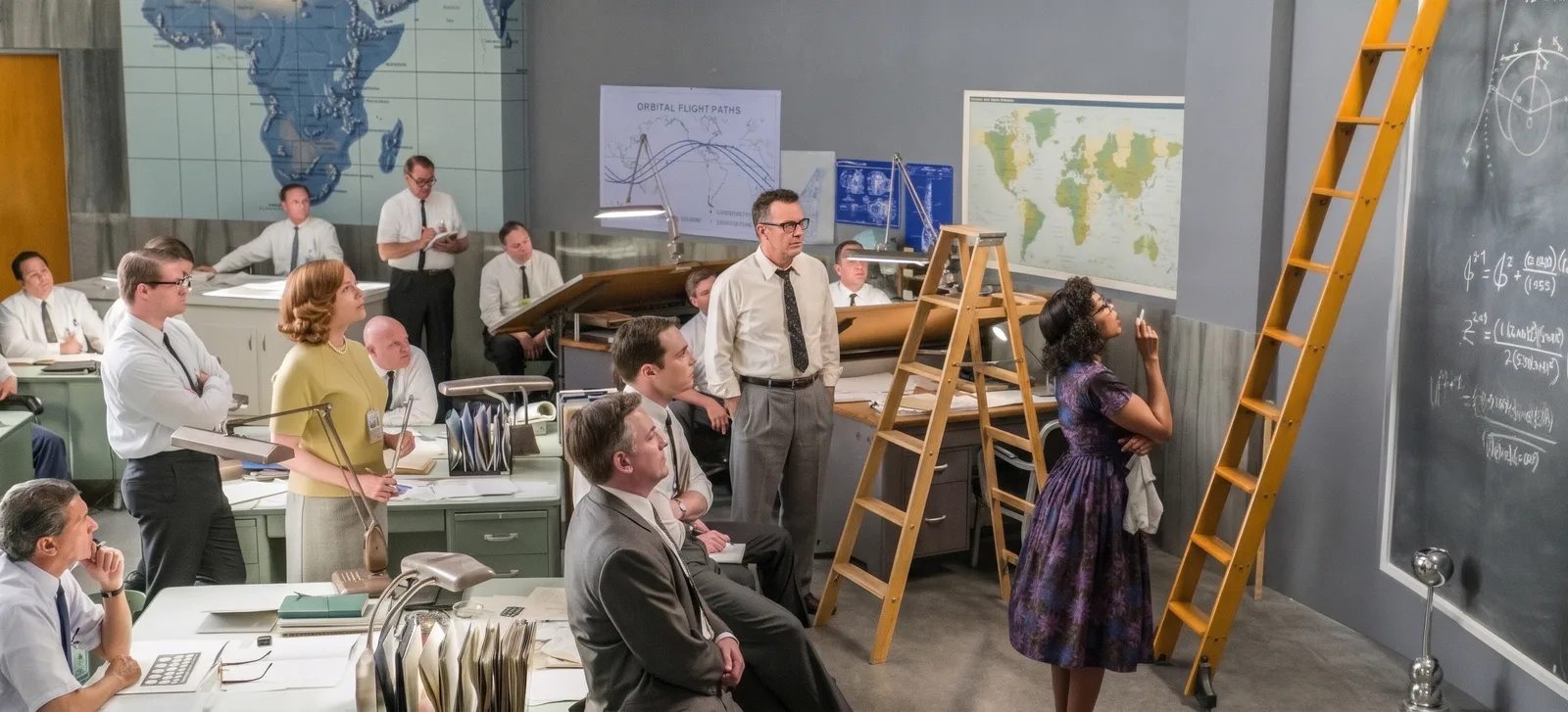
PS AI Disclosure statement; Gemini used to recreate me standing in the room of Hidden Figures (2016) replaced that Costner chap.