
Sure the average AI chat session is all cool, but it has no idea about your world. What if it did?
You ask Claude about your database and it hallucinates table names. You ask it to check your logs and it invents file paths. The model is smart but blind. It cannot see your systems.
The Model Context Protocol fixes this. Anthropic built MCP as an open standard to connect AI tools directly to your infrastructure. Instead of copying and pasting data into a chat window, you give the model a way to reach in and query your systems itself.
The protocol is simple. JSON-RPC 2.0 messages. The AI sends a request to your server asking what tools are available. Your server responds with a list. The AI picks a tool, sends parameters, your server does the work, and returns the result. No magic. Just structured communication.
You build these servers as small Node.js applications. They connect to the AI host in one of two ways. Standard I/O runs the server as a child process on your local machine. Server Sent Events runs it over the network so your whole team can use it. Standard I/O is more secure because there is no network port to attack. SSE is more flexible because you host it once and everyone connects.
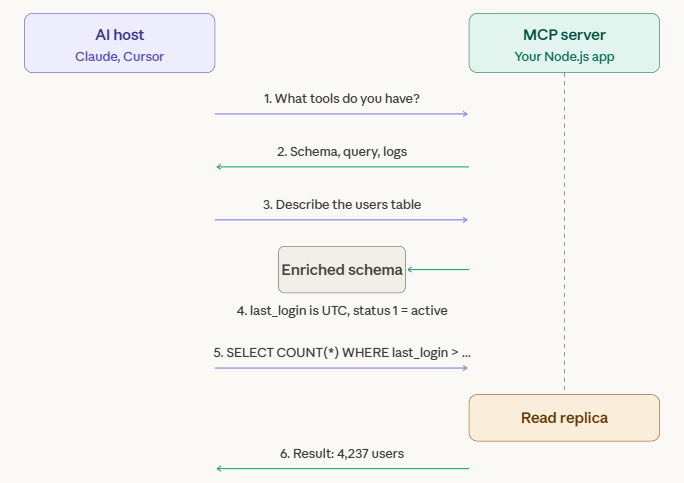
Say you ask the AI how many users logged in yesterday. Here is the sequence.
- The AI asks your MCP server what tools it has. Your server returns a list. One of them is a schema tool that describes your database tables.
- The AI calls that tool. Your server returns an enriched description. Not just column names. You add context. You note that last_login is stored in UTC. You explain that status 1 means active.
- Now the AI writes a proper SQL query. It gets the date filters right because you gave it the background knowledge. It passes the query to your server. You run it against a read only replica so production stays untouched. The result comes back and the AI gives you a clear answer.
This is the real power. You connect your database, your logs, your internal APIs. The AI navigates your entire organization through one protocol.
If you paste database passwords into a system prompt, you are creating a security hole. A proper MCP server handles its own configuration. The credentials live on your side of the connection. The AI never sees them.
Go further. Register separate credentials for the MCP server. Use OAuth tokens tied to individual users. When your support team queries the system, the server uses their identity. If someone tries to access data they should not see, your existing permissions reject the request. The database remains the source of truth for access control.
Third party MCP servers already exist. Atlassian has one. So do Slack, GitHub, and others. You connect them and your AI can search Jira tickets or pull Confluence pages. This works. But you lose control over context.
When you build your own server, you control what comes back. You call the Atlassian API yourself and enrich the response before the AI sees it. A raw Jira ticket is just fields. Your server can add notes explaining that PROJ-123 is the payments refactor, that it blocked the Q3 release, and that Sarah owns it. The AI writes better queries and gives better answers because you gave it the background knowledge.
Third party servers are faster to set up. Your own servers are more powerful. For core business systems, build your own.
Some people argue you can do all this with command line tools. True for a single developer. Impossible to scale. You do not want your non-technical employees managing AWS tokens and environment variables. A central MCP server wraps all of this into one application. You maintain security in one place. Everyone benefits.
MCP turns your AI into something that actually understands your business. You stop spending time on clever prompts and start building real infrastructure. Your developers automate tasks across systems. Your non-technical staff query production data safely.
I have created advanced dashboards that summarize a given micro-service, across multiple data sources (AWS, database, logs, 3rd party dependencies), saved it off as a skill, so I can quickly reproduce everything into a single pane-of-glass that gives me a holistic view. I see my AWS cost for RDS is up, I can also see the number of messages I am processing has also gone up. Joining the dots right in front of me.

Think of your MCP server as a personal concierge. It knows your systems. It knows your terminology. It knows where the data lives and what it means. When you ask a question, the concierge goes and finds the answer for you. It queries the right databases, checks the right logs, and translates everything into context the AI can use.
You stop copying and pasting. You stop explaining your environment over and over. You just ask the question and get the answer.
AI Disclaimer: Gemini Nano Banana Pro was used to generate the photo – from the 2014 The Grand Hotel Budapest.


![[Review] PostgreSQL Mistakes and How to Avoid Them](https://alan.is/wp-content/uploads/2026/02/mycousinvinny-small.png?w=643)
 Alan Williamson