
I have a long list of hobby projects I want to do when I get round to it. One was a game that would let me have an old school arcade driving game on top of real maps (such as Google Maps or OpenStreetMap). Drive from one end of Richmond to the other. What is the quickest way? Given all the different paths. Use real roads with real geography.
I thought this would be perfect for trying vibe coding from the start. Hands off. Let the agent build it. See how well it does. I wanted to test the limits of how far you could get without looking at code.
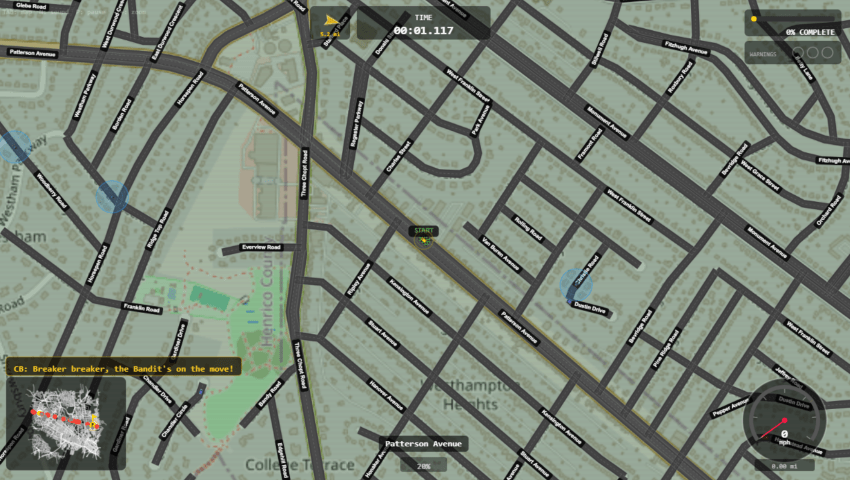
The result was a browser based game with Claude that you can play it now. The game works very well and is fun to race around real streets, avoiding police cars as you get to your destination. Choose from anywhere in the world, and even share the race with a friend to compare. What is there not to like?
Yet I feel no pride of ownership. The repository sits on GitHub under my name with a GPL license because honestly, I am not sure who should own this. Not me. Not Claude. Maybe no one.
This took five nights. It was not quick. But it was definitely quicker than doing it from scratch. Had the model gone offline at any point, I would have been stuck. Zero progress.
What I expected was to be hands off but still involved in the process. What I got was watching an agent scroll through actions while it talked to me about what it was doing. I was observing someone else build something. It was dull.
Eventually I looked at the code. Repeated blocks everywhere. The kind of thing you see from someone who does not know better or does not care. Could I have specified upfront not to do that? Yes. But the point of vibe coding is supposed to be that you do not have to think about every detail.
Then there were performance issues. The map loading from OpenStreetMap went nowhere. It failed quickly and never thought to implement retry mechanisms. It never considered loading tiles instead of vectors. I had to think like an architect and nudge it in the right direction.
That was when I realized what this actually was. I was not collaborating with AI. I was mentoring a junior developer who kept insisting everything was fine when it clearly was not. I got tired of typing the same corrections and switched to WisprFlow for dictating to it instead. Faster and yet still just a spectator.
When the agent said it was done, I had another model review the code. That model found plenty of issues. I brought those back to Claude and it agreed with every single one. What a minute? Claude had already proudly declared the work ready when I had asked it if anything else needed doing.
A good developer never does that. There is always something that can be better. There is always another pass you can make. So how do you trust the output when the agent has no real quality bar?
The game is fun. I have played it myself beyond just testing. But I do not feel pride in it. I do not feel ownership. I put “Alan and Claude” on the splash page, but I am not kidding myself. I do not know how the game really works. I was not there for most of it.
The GPL license felt right because if you can prompt AI to create something, so can anyone else. There is no craft in that. There is no unique insight. The code is built on patterns learned from millions of developers who actually wrote code, debugged it, understood it, improved it. Me claiming ownership because an AI model managed to find the right pattern feels ethically wrong. I want to go deeper into that in a later blog piece, as I am still formulating my thoughts.
I use AI every single day in my work. It checks behind me. It writes functions I cannot be bothered to do myself. It handles tests and documentation. I still feel ownership of that work because my experience is embedded throughout. I am making the architectural decisions. I understand every piece even if I did not type all of it.
Vibe coding is different. It crosses from tool into ghost writer when you never look at the code. And in any real project, there will too much code to read every line. You are going to have to trust it. I hear stories from my fellow CTO’s in the field they have created pipelines of agents checking the output of the previous one; which just feels like a spiral down the way.
Where is the line then? If the AI output is not making you a stronger or a better developer, then do not confuse speed of delivery with understanding.
I set out to build something eyes off. The game exists. You can play it now. But I learned nothing. Not about game development. Not about architecture. Not about problem solving. The destination was fine. The journey was flat.
If you enjoy destinations no matter how you got there, vibe coding might work for you. But do not confuse prompting something into existence with understanding what you created. You do not know why something is the way it is. Maybe you do not care. That is fine. Own it honestly.

Do not give me credit for building a complicated Lego model when all I did was follow instructions. The real credit goes to the Lego architect who designed the model. Here, the code was not mine. I stopped being a developer and became a client directing an outsourced developer.
In the mean time, go and play it, have fun, pretend to be Burt Reynolds, as he evades the smokeys!
https://a1anw2.github.io/smokeysandthebandit/
AI Disclaimer: Gemini Nano Banana Pro was used to generate the photo – from the ’77 Smokey and the Bandit with me as Jnr.



 Alan Williamson