
Every time I see emoji’s used as document headings, my eyes rolled in the back of my head.
Not in a casual Slack message. In a proposal but a proper, sent-to-impress, please-take-us-seriously business proposal. There was a rocket ship. There was a lightbulb. There was a ‘key takeaways’ section with a little key.
I could not be arsed reading it. And I mean that seriously, not as a complaint. I have a team to lead, decisions to make, and people waiting on me. I do not have time to wade through four paragraphs of AI-generated throat-clearing to find the one sentence that actually mattered. Nobody does. And the fact that you spent thirty seconds prompting something into existence and then forwarded it to me like it represents your thinking, that is what I take issue with.
Nobody had read it before it was sent that part easy to tell.
Here is the thing that started bothering me wasn’t AI supposed to make my life simpler? I was supposed to read less, not more. The promise was always efficiency. Clarity, signal over noise. Instead I am drowning in four-paragraph Jira tickets that contain one sentence of actual information. Proposals that run to twelve pages when the ask is on page nine. Meeting notes that read like a transcript of a transcript, summarized by something that has never attended a meeting in its life.
This can’t be good for us.
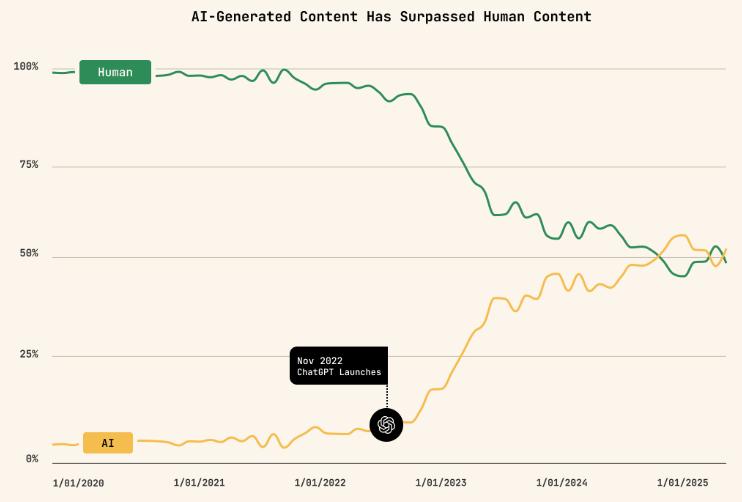
We are producing more content than at any point in history, and reading less of it. A study by SEO firm Graphite, analyzing over 65,000 articles, found that AI-generated content crossed 50% of all new web articles in November 2024. Before ChatGPT, that number was 5%. Meanwhile, the average human attention span on a screen has dropped to 47 seconds, down from two and a half minutes in 2004, according to UC Irvine researcher Dr. Gloria Mark. We are filling a bigger bucket with a smaller cup.
This starts to make the “Dead Internet” believable. A theory positing that the internet as a human-dominated space largely died around 2016, and has since been replaced by algorithmically curated content, artificial intelligence, and automated bots designed to manipulate the population, farm engagement, and generate revenue (Wikipedia).
I am wondering are we approaching “Dead Company Confluence” – where the wiki or knowledge base of the company is largely AI generated, with little or no human input. I think so.
A University of Melbourne and KPMG study of 48,000 people across 47 countries found that 66% of employees accept AI output without checking its accuracy, and 56% have made actual work mistakes because of it. Developers are no different. Sonar’s 2026 State of Code survey found that 96% of developers don’t fully trust AI-generated code, yet only 48% bother to check it before they ship it. The other 52% are just rolling the dice.
And yet nobody seems embarrassed about any of this. That is the part that gets me. The proposal did not arrive with an apology. It arrived with confidence. People are circulating this stuff, putting their name on it, and expecting to be taken seriously. Volume has become a proxy for effort. Length has become a substitute for thought. The more it looks like work, the less anyone questions whether any actual work went into it.
It didn’t use to be like this. We use to practice brevity, we even had a name for it: KISS – Keep It Simple, Stupid.
A rule built precisely to stop us over complicating something or drowning each other in noise. Say what needs to be said, nothing more. Somewhere along the way we abandoned it entirely.
A Reddit user going by /u/gooseberryhandler posted the perfect name for what replaced it. BOVINE – Being Overly Verbose In Needless Expositions. I have not been able to get it out of my head since I saw it, because it describes almost every AI-assisted document I have received in the past twelve months.
BOVINE
Being Overly Verbose In Needless Expositions
This is not a new impulse. People have always used volume as a substitute for substance. The person who said “utilize” instead of “use” to sound clever in a meeting. The consultant who delivered a 60-slide deck when the answer was one page. AI has simply industrialized that instinct and put it on a subscription plan. We are not becoming more intelligent by using it this way. We are becoming artificially intelligent. Performing the appearance of thought, without doing any of the actual thinking.
The irony is that AI is genuinely good at the opposite. Ask it to take your five-paragraph explanation and cut it to two sentences. Ask it to strip the noise out of a document and leave only the decisions. Ask it to read the twelve-page proposal and tell you what is actually being asked. That is AI working for you.
What it was not built to do is think for you, and then have you pass the output off as thinking. That is just copying someone else’s homework. We all knew someone at school who did it (and those in the corporate world that continue to do so). We all knew it was obvious – there is no way Michael became a physics genius overnight. It is just as obvious now, and the emoji headings are still the tell.
If this is you – stop it. No more BOVINE.
KISS still works and the world needs a little more love.
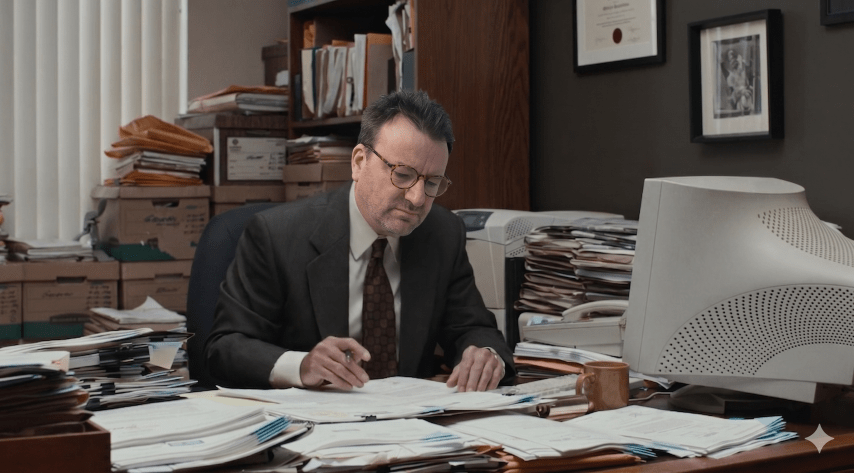
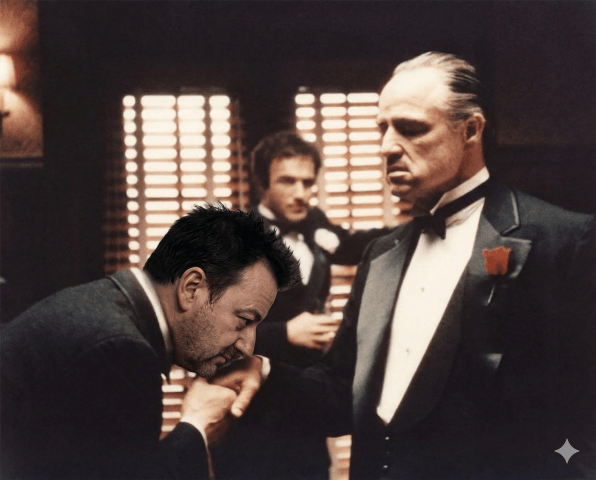
AI Disclaimer: Gemini Nano Banana Pro was used to generate the photo – from the 2015 Spotlight movie, with Stanley Tucci.




 Alan Williamson