
When was the last time you sat in a meeting that didn’t have an AI bot taking notes?
It used to be a novelty. Someone would politely ask if it was okay to record. Now it’s presumed on by default. Teams, Zoom, Google Meet all have it baked in. It’s evolved from screen capture to full AI analysis, complete with who talked the most. Have you seen those? God awful feature.
Then came the wave of apps like Granola that sit in every meeting without anyone realizing they’re being recorded and analyzed in real time. This has broken out of the workplace. It’s on dates. At family gatherings. Cell phones on the table, quietly recording every detail, giving you a full debrief on Uncle Fred’s Thanksgiving meltdown.
The WSJ recently covered Yuzu Labs founder Emmie Chang, who admitted she uses these on dates to rate how well they went. Oh dear. Where does it end? Do we bring an AI agent into the bedroom to rate the sex? Was that orgasm louder than last week’s, and which lines of dialogue most influenced the outcome?
I’m joking. Mostly. Chang wants to hone her dating to a fine art. But to what end? You’re building a fabricated version of yourself designed to win the date. Then what? How do you sustain that?
The last round of interviews I conducted, I was amazed how many candidates had their AI bot waiting in the lobby, hoping to be let in. Most didn’t ask. Those that did got a look that said “seriously?” But who am I kidding, they were recording anyway.
I hate these things. Loathe them.
Because when you have your “lawyer” sitting beside you, recording every word for eternity, it changes everything. People clam up. They filter. Humor doesn’t translate. Passive aggressive behavior gets amplified. Everyone starts gaming the AI productivity score, counting how many times someone says “let’s table that.“
Whether it’s a meeting, a date, or Thanksgiving dinner, we stop interacting and start performing. We’re losing ourselves to a persona optimized for the algorithm.

Amy Dufrane, CEO of the Human Resource Certification Institute, says companies should ban them outright. Alex Alben (privacy lawyer, an actual lawyer) warns it puts employers in a legal minefield.
- Who owns that Granola recording from a workplace meeting?
- Can I subpoena it from Henry if I think he slighted me and use it to file an HR complaint?
- What happens if it goes public?
- Who can sue who?
I’ve seen this before. Management starts pushing for all meetings to be recorded. It becomes a running joke in the pre-meeting amble: “oh here’s the consent piece.” Nobody is going to say no because it’s a subtle form of corporate bullying. And it works. The free flow of ideas die. Meetings become stale as everyone watches their words.
Maybe employee handbooks need their own version of the Miranda rights.
You have the right to remain on mute. An AI assistant will document your spoken statements and add them to your employee record. You have the right to request a transcript review. If you discuss inappropriate workplace topics, HR will schedule a mandatory compliance discussion with you.
We all have a right to some degree of privacy.
This isn’t a problem with the technology itself. AI note taking is genuinely useful when things need to be formally documented, like board meetings or annual reviews. Even then, I want multiple independent AI stenographers, not a single vendor who will converge on a shared interpretation.
The question isn’t “can we” but “should we.” Context is a big word in AI, but in this space it’s completely lost. This is what I call ethical AI; using the tool in the places it can provide the most advancement, without changing who we are fundamentally.
Resist. Say no. Make the uninvited AI note takers socially unacceptable so they no longer influence the tone.
We had that normal human interactions once. We let it slip. Time to take it back.
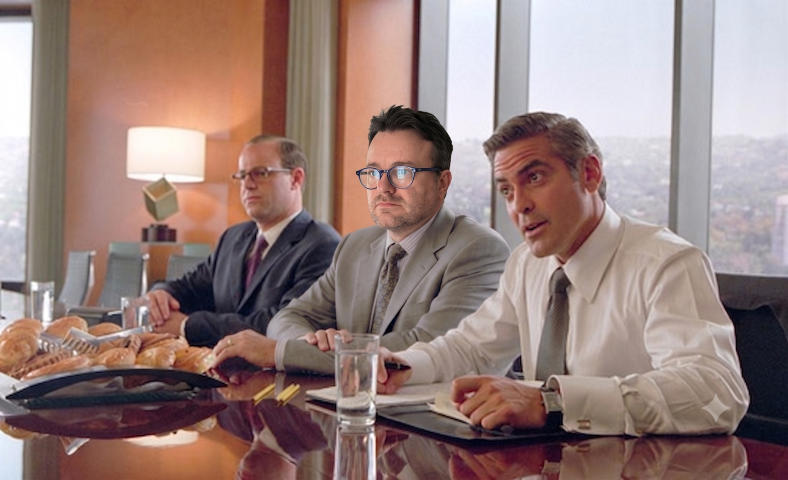
AI Disclaimer: Gemini Nano Banana Pro was used to generate the photo from the movie Intolerable Cruelty (2003)



Leave a Reply